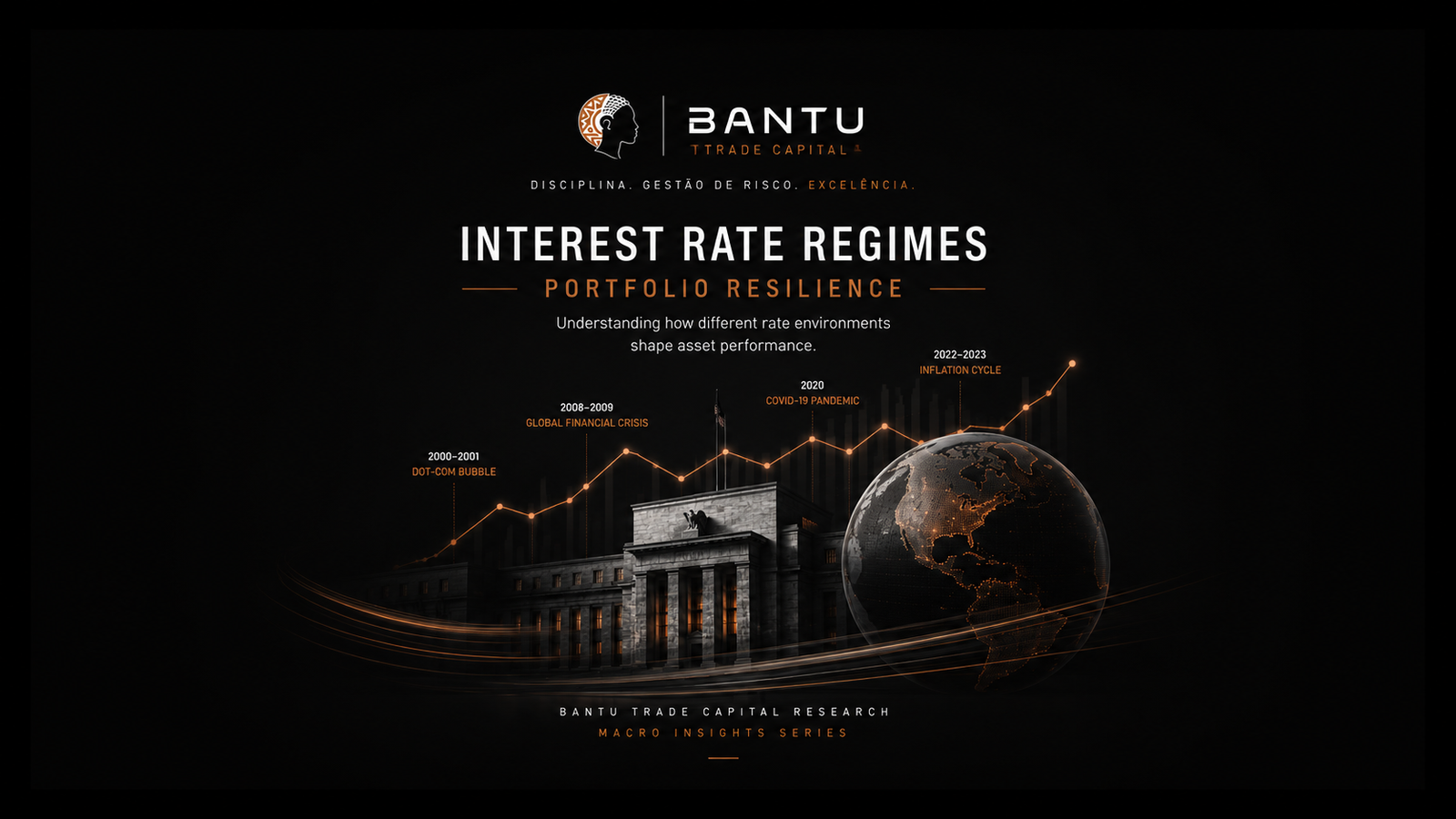
Interest Rate Regimes: A Framework for Portfolio Resilience
Central bank policy moves in cycles. Here's the framework we use to think about positioning across different rate environments.
Introduction
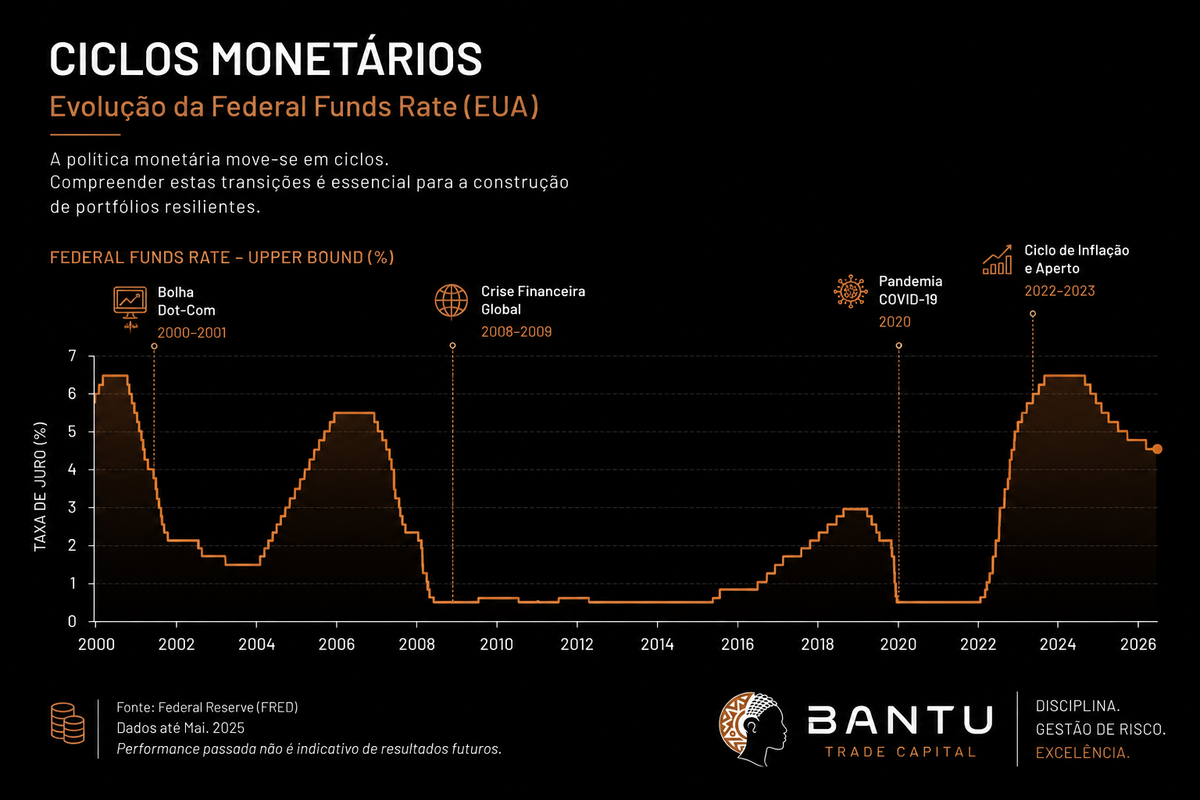
Monetary policy moves in cycles.
Periods of low interest rates are often followed by tightening phases. Restrictive policy eventually gives way to easing cycles as economic growth slows and inflation pressures subside. For investors, understanding these transitions is essential.
Different interest-rate environments create different winners and losers across asset classes. Portfolios constructed for one regime may become increasingly vulnerable when the macroeconomic backdrop changes.
At Bantu Trade Capital, we believe portfolio construction should not depend on predicting the exact path of central bank decisions. Instead, the objective is to understand the characteristics of different monetary regimes and build resilient portfolios capable of adapting across changing environments.
Why Interest Rates Matter
Interest rates represent the price of capital.
They influence:
- Economic growth;
- Corporate financing conditions;
- Consumer spending;
- Asset valuations;
- Liquidity conditions;
- Risk appetite across global markets.
Changes in monetary policy affect virtually every financial asset.
A lower discount rate increases the present value of future cash flows, generally supporting equities and long-duration assets. Conversely, higher rates increase financing costs, reduce liquidity and place pressure on valuations.
For this reason, monetary policy remains one of the primary drivers of asset performance.
The Four Interest Rate Regimes
1. Falling Rate Environment
Characteristics
- Economic growth slows.
- Inflation pressures moderate.
- Central banks begin easing policy.
- Liquidity conditions gradually improve.
Historically, falling-rate environments have tended to favour duration-sensitive assets.
Potential beneficiaries:
- ✓Government bonds
- ✓Growth equities
- ✓Technology sectors
- ✓Real estate assets
Lower discount rates increase the valuation of long-duration cash flows, often supporting growth-oriented companies.
At the same time, declining yields typically improve bond performance and reduce financing stress across the economy.
Risks:
- Recession concerns;
- Earnings deterioration;
- Credit events during economic slowdowns.
2. Low and Stable Rate Environment
Characteristics
- Inflation remains contained.
- Economic growth is stable.
- Liquidity conditions are supportive.
- Financial conditions remain accommodative.
This environment characterised much of the post-Global Financial Crisis period.
Potential beneficiaries:
- ✓Equities broadly
- ✓Credit markets
- ✓Private assets
- ✓Risk assets in general
Abundant liquidity and low financing costs often encourage investors to move further along the risk spectrum.
However, prolonged periods of low rates may also contribute to excessive risk-taking and elevated asset valuations.
Risks:
- Asset bubbles;
- Excessive leverage;
- Mispricing of risk.
3. Rising Rate Environment
Characteristics
- Inflation accelerates.
- Central banks tighten policy.
- Financial conditions become more restrictive.
- Liquidity gradually contracts.
Historically, rising-rate environments tend to create challenges for both equities and fixed income.
Higher discount rates reduce valuation multiples, while rising yields negatively impact bond prices.
Potential beneficiaries:
- ✓Commodities
- ✓Energy sectors
- ✓Financial institutions
- ✓Short-duration instruments
Potential headwinds:
- ✗Long-duration bonds
- ✗High-growth equities
- ✗Highly leveraged businesses
Periods of aggressive tightening often produce greater market volatility as investors reassess economic expectations and earnings assumptions.
4. Higher-for-Longer Environment
Characteristics
- Inflation remains persistent.
- Central banks maintain restrictive policy.
- Real rates stay elevated.
- Liquidity conditions remain constrained.
This environment can be particularly challenging because neither bonds nor equities necessarily provide the diversification benefits investors have historically relied upon.
The experience of 2022 highlighted this dynamic.
Traditional portfolio structures experienced significant pressure as both asset classes declined simultaneously.
Potential beneficiaries:
- ✓Cash and short-term instruments
- ✓Select commodities
- ✓Relative-value strategies
- ✓Active management approaches
This regime generally increases the importance of:
- Security selection;
- Risk management;
- Portfolio flexibility;
- Tactical asset allocation.
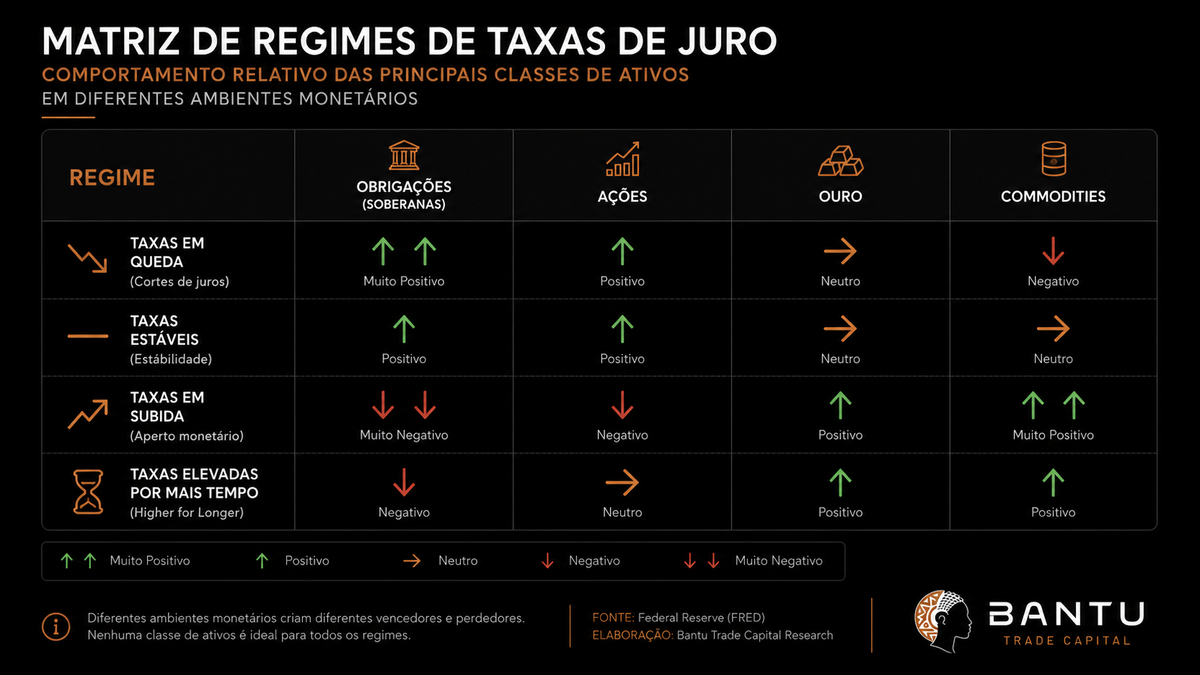
Interest Rate Regimes and Asset Behaviour
| Asset Class | Falling Rates | Stable Rates | Rising Rates | Higher for Longer |
|---|---|---|---|---|
| Government Bonds | Strong | Positive | Weak | Mixed |
| Growth Equities | Strong | Positive | Weak | Weak |
| Value Equities | Moderate | Positive | Moderate | Moderate |
| Commodities | Weak | Neutral | Strong | Strong |
| Gold | Moderate | Neutral | Positive | Positive |
| Cash | Weak | Neutral | Strong | Strong |
This framework is not intended as a prediction tool.
Rather, it provides a structured way of thinking about how different assets may respond under changing macroeconomic conditions.
The Role of Portfolio Resilience
Attempting to predict every central bank decision is inherently difficult.
Monetary policy is influenced by numerous variables:
- Inflation dynamics;
- Labour market conditions;
- Fiscal policy;
- Geopolitical developments;
- Financial stability considerations.
Forecasting errors are inevitable.
As a result, resilient portfolio construction should place greater emphasis on preparation than prediction.
Key principles include:
Diversification
Avoid excessive concentration in a single macroeconomic outcome.
Liquidity Management
Maintain sufficient flexibility to adapt as conditions evolve.
Risk Budgeting
Define acceptable downside scenarios before capital is deployed.
Scenario Analysis
Evaluate portfolio behaviour under multiple policy paths rather than relying on a single forecast.
Lessons from Recent Cycles
The last two decades have demonstrated how rapidly monetary environments can change.
- The post-2008 period was defined by exceptionally low rates and abundant liquidity.
- The post-pandemic environment introduced the sharpest tightening cycle in decades.
- Investors accustomed to one regime suddenly faced an entirely different investment landscape.
These transitions reinforce a critical lesson:
The future rarely resembles the recent past.
Building portfolios exclusively for the previous regime can leave investors exposed when macro conditions shift.
Conclusion
Interest-rate cycles remain among the most important drivers of global asset performance.
Different environments create different opportunities and risks. No single asset allocation performs optimally across all regimes.
At Bantu Trade Capital, we believe effective capital management requires a disciplined understanding of macroeconomic cycles, robust risk management frameworks and the flexibility to adapt as conditions evolve.
Rather than attempting to predict every policy decision, our approach focuses on building resilient portfolios capable of navigating multiple economic environments.
Because in investing, preserving capital through changing regimes is ultimately more important than forecasting the next central bank move.